Category: Cost Estimation

Digital Transformation Cost in Dubai, UAE: Full 2026 Budget Guide

At 9:10 a.m., the COO of a mid-sized Dubai logistics company was staring at three different reports that showed three different revenue details.

Operations had one version. Finance had another. Sales were working off a spreadsheet that someone had manually updated the night before. The issue wasn’t effort; it was systems that couldn’t scale with the business anymore.

So the leadership team asked the only question that mattered:
“How much does digital transformation cost in Dubai, UAE, and how fast can it start paying us back?”

They’re not alone. As the UAE’s digital transformation market climbs from $1.82 billion in 2026 to a projected $3.75 billion by 2031. Companies across industries are moving from patchwork tools to connected, data-driven operations. The real challenge isn’t whether to invest; it’s how to budget for it with ROI in mind.
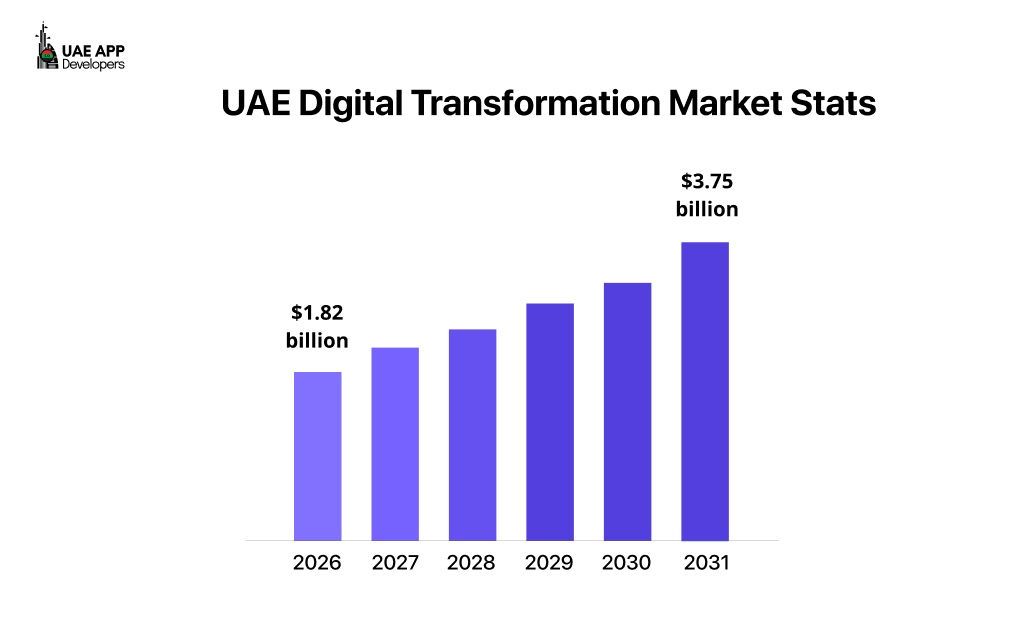
UAE digital transformation stats

This guide breaks down the digital transformation cost in UAE through that exact lens: what you’ll spend, what drives the numbers, and how to turn the investment into a scalable growth engine. But first, you must know why digital transformation is a business priority in the UAE.

Why is Digital Transformation a Business Priority in Dubai?

In 2024, the UAE contributed 0.9% of the global digital transformation market by revenue. This is one of the biggest reasons, but other than the revenue of the market, there are three more reasons; take a look at them.
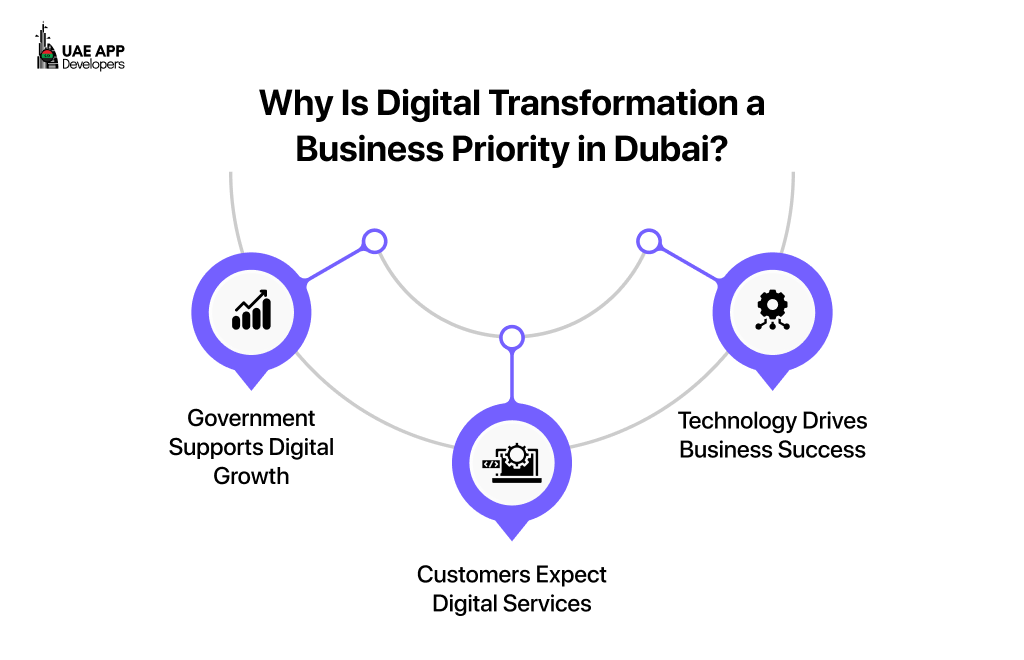
reasons why Digital Transformation a Business Priority in Dubai

1. Government Supports Digital Growth

Dubai’s economic vision is structurally digital. From licensing to payments to compliance, the direction is clear: businesses that operate on connected, automated, Cloud-based systems move faster.

This is why digital transformation investment in the UAE continues to rise across sectors. The government is not just promoting innovation; it is redesigning how companies interact with the economy. 

In a market shaped by UAE digital economy growth, the real risk is not overspending on technology; it is becoming structurally slow.

2. Customers Expect Digital Services

Dubai’s customers already live in a real-time environment. They expect instant onboarding, seamless payments, personalized interactions, and always-on support. 

Digital transformation directly improves:

  • Speed of sales
  • Customer retention
  • Cross-sell potential

That’s why high-growth companies treat digital experience as a core product.

In a region where the digital transformation market size is expanding rapidly, customer expectations are being set by the best platforms.

3. Technology Drives Business Success

Digitally mature companies in Dubai launch faster. They enter new markets with lower marginal cost. Make decisions using real-time data. And automate repetitive overhead.

As a result, revenue grows faster than staffing, and expansion does not require proportional cost increases. That is the definition of a scalable business.

Digital transformation enables:

  • Predictable forecasting
  • Integrated revenue systems
  • Data-backed pricing strategies
  • Faster product iteration

In other words, technology is no longer a support function. It is the foundation of business performance.

Partner with UAE App Developers to turn your business digitally

That urgency brings the focus to one thing: investment. So, what does digital transformation actually cost in Dubai in 2026?

How Much is the Average Digital Transformation Cost in Dubai? (2026 Overview)

The cost of digital transformation depends on the company’s size and the automation you choose to add to the project. The average digital transformation cost in Dubai, UAE, ranges from AED 100,000  (USD $30,000) for small companies to AED 2,500,000+ (USD $500,000+) for enterprises. 

Below in the table, you’ll see all the information:

Company Size Cost in AED Benefits
SMEs AED 100,000-500,000+ Basic automation, software development & chatbot
Mid-sized Companies AED 300,000-1,000,000+ CRM upgrades, cloud migration, or complex process automation
Enterprises AED 900,000-2,500,000+ full-scale, AI-driven, custom systems with high security.

Company size alone does not determine your transformation budget. The technology you choose has a direct impact on the overall investment. System complexity, integration requirements, and levels of customization also affect costs.

All of these factors together shape the final cost of software development in the UAE.

Digital Transformation Cost Breakdown by Technology

Cloud and edge computing led the UAE digital transformation market with a 29.65% share in 2025. Analytics and AI are the fastest-growing segments, projected to expand at a 27.2% CAGR through 2031.

So the real question is: how much do these technologies cost, and what factors influence that cost?

➜ Cloud Migration Cost in Dubai

Cloud migration costs in Dubai depend on how complex your current infrastructure is and how fast you want to move. From data transfer to application refactoring, every decision directly impacts the final budget.

What drives the cost: 

  • Legacy system complexity
  • Data volume and dependencies
  • Re-architecture vs lift-and-shift
  • Security and compliance requirements
  • Downtime tolerance

➜ ERP Implementation Cost

In high-growth companies, ERP becomes the backbone for multi-entity scale. Without it, expansion creates operational chaos.

ERP is where digital transformation stops being a tech project and becomes a company-wide operational rewrite. You’re standardizing finance, supply chain, HR, pro curement, and reporting into a single system. 

What you’re really paying for

  • Process redesign
  • Data migration and cleansing
  • Custom workflows
  • Change management

➜ CRM Implementation Cost

CRM is not a software decision. It’s a revenue architecture decision. In Dubai’s competitive, relationship-driven market, CRM defines:

  • Pipeline predictability
  • Sales productivity
  • Customer lifetime value

A properly implemented CRM:

  • shortens sales cycles
  • increases win rates
  • improves upsell and cross-sell
  • aligns marketing and sales data

That’s why it’s one of the fastest payback investments in any transformation roadmap.

➜ AI & Business Process Automation Cost

This is where the conversation shifts from digitization to margin expansion. The AI digital transformation cost, UAE companies are investing in today is focused on:

  • Workflow automation
  • Predictive analytics
  • Intelligent customer experience
  • Decision support systems

➜ Data Analytics & Integration Cost

Every transformation eventually hits the same wall. You have tools. But you don’t have a single source of truth. That’s where data integration and analytics come in.

Companies that invest here move from:

Reactive reporting → Predictive operations.

That’s a fundamental competitive advantage.

Cost vs ROI: Is Digital Transformation Worth the Investment?

Area Cost (AED) Core ROI Driver Business Impact Payback
Cloud Migration 80K – 2M+ Speed & scalability Faster launches, lower infra dependency 12–24 months
ERP 150K – 3M+ Process control Real-time finance, operational efficiency 18–36 months
CRM 60K – 2M+ Revenue predictability Higher conversions, better retention 6–12 months
AI & Automation 120K – 5M+ Margin expansion Less manual work, higher output per employee 12–30 months
Data & Analytics 100K – 1M+ Smarter decisions Churn reduction, demand forecasting 12–24 months

7 Key Factors That Influence Digital Transformation Cost in the UAE

So the real focus shifts to the factors that impact the cost of digital transformation in Dubai, UAE. Below are the key elements that directly shape how much businesses actually invest.
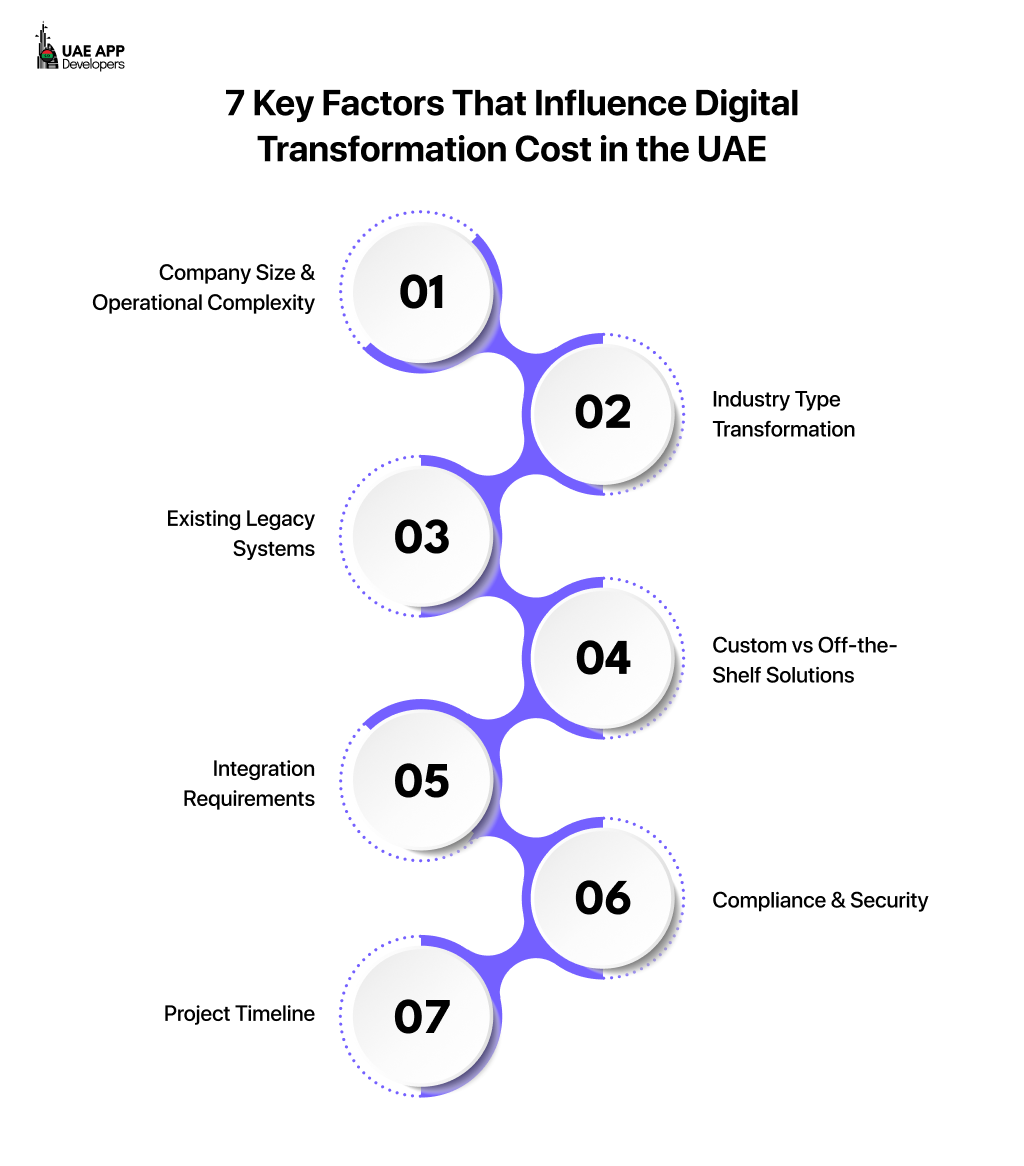
Factors That Influence Digital Transformation Cost in the UAE

1. Company Size & Operational Complexity

Company size is the biggest factor affecting the cost of digital transformation in the United Arab Emirates. If complexity isn’t structured through digital systems, growth multiplies inefficiencies. The transformation cost here is an investment in future operating leverage.

The Digital transformation costs increase when you have:

  • Multiple business units
  • Cross-border operations
  • Fragmented approval workflows
  • Disconnected financial reporting

2. Industry Type Transformation

In Dubai, industry context changes everything. A retail brand digitizing customer journeys and a logistics company automating fleet operations may spend similar amounts but for completely different reasons.

Your industry defines whether transformation is about efficiency, experience, compliance, or speed to market, and that directly shapes the budget.

3. Existing Legacy Systems

Legacy infrastructure is where transformation budgets either double or become phased investments.

Suppose your core systems are undocumented, heavily customized, and dependent on manual workarounds. You’re not modernizing, you are untangling operational history.

This adds cost through:

  • Data cleansing
  • Migration risks
  • Temporary parallel systems
  • Re-engineering integrations

4. Custom vs Off-the-Shelf Solutions

This is one of the most misunderstood cost decisions. Off-the-shelf looks cheaper at the start. Custom looks expensive. But the real question is:

Are your processes your competitive advantage or not?

Choose Off-the-Shelf When Choose Custom When
  • Speed matters more than differentiation
  • Your workflows are standard
  • You’re optimizing for cost control
  • Your revenue model is unique
  • Customer experience is your moat
  • Automation directly impacts margins

Remember, customization increases upfront cost but reduces long-term operational constraints. And Off-the-shelf reduces initial investment but may introduce scaling friction later.

5. Integration Requirements

The highest hidden cost in UAE transformation projects is not software. It’s getting systems to talk to each other. Without integration, you don’t have transformation. You have digital barriers.

Every integration adds:

  • API development
  • Middleware
  • Data mapping
  • Testing and monitoring layers

6. Compliance & Security

Investors and enterprise clients increasingly evaluate companies based on their digital trust architecture. In Dubai and the wider UAE, compliance is not optional. 

Data protection, financial regulations, and sector-specific governance frameworks increase:

  • Infrastructure requirements
  • Hosting decisions
  • Access control systems
  • Audit capabilities

7. Project Timeline

Speed changes cost. Not because vendors charge more for urgency, but because acceleration requires:

  • larger implementation teams
  • parallel execution
  • faster testing cycles
  • greater change management intensity

Here is a short explanation of the project timeline. 

A 12-month transformation spreads the cost. A 4–6 month transformation compresses it.

But here’s the strategic trade-off:

Faster execution means faster ROI, earlier operational efficiency, and quicker market advantage.

get into the digital market with UAE app developers

That’s the overall benchmark. Now let’s break it down by industry.

What is the Digital Transformation Cost by Industry in Dubai?

This section shows you different industry types of digital transformation cost in Dubai, United Arab Emirates.
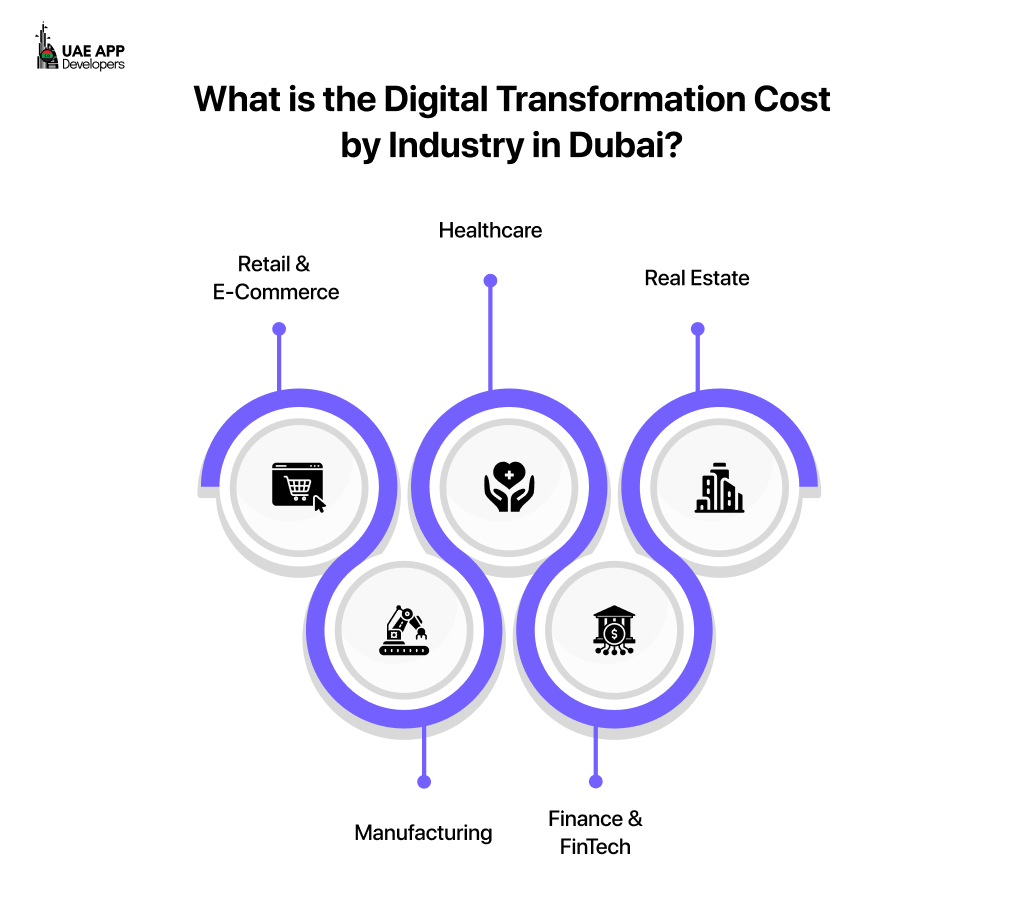
Digital Transformation Cost by Industry in Dubai

★ Retail & E-Commerce

In retail, transformation is directly tied to revenue velocity. The retail digital transformation cost typically flows into:

  • Omnichannel commerce platforms
  • Real-time inventory systems
  • Customer data and personalization engines
  • AI-driven demand forecasting

Retail requires continuous iteration. Your platform is never “done”, which means transformation shifts from a one-time capex project to a growth-aligned investment.

Cost: AED 70,000-2,500,000

★ Manufacturing

In this industry, transformation is about margin protection and operational control. The manufacturing digital transformation cost is typically driven by:

  • IoT-enabled production monitoring
  • ERP modernization
  • Predictive maintenance systems
  • Supply chain visibility platforms

In a logistics-heavy hub like Dubai, where manufacturers serve global markets, digital operations create a major advantage: you scale output without scaling complexity.

Cost: AED 150,000-3,000,000

★ Healthcare

Healthcare transformation is compliance-heavy, integration-heavy, and mission-critical. The healthcare digital transformation cost usually centres around:

  • Electronic medical records (EMR/EHR)
  • Telehealth platforms
  • Patient experience systems
  • Data security and regulatory infrastructure

This makes it one of the highest-risk, highest-impact investments.

Why healthcare leaders in Dubai are still accelerating it:

  • Patient expectations are digital-first
  • Operational efficiency directly increases capacity
  • data unlocks new revenue models (preventive care, remote care, subscription health)

Cost: AED 120,000-3,000,000

★ Finance & FinTech

For financial institutions, transformation is not an upgrade. It’s survival. The Fintech digital transformation cost in Dubai is driven by:

  • Core banking modernization
  • Digital onboarding
  • Fraud and risk automation
  • API-led ecosystem integration

In Dubai’s fintech ecosystem, speed is the product.

Cost: AED 300,000-3,000,000+

★ Real Estate

Real estate in Dubai is undergoing a platform shift. The proptech digital transformation cost is typically invested in:

  • Smart property management systems
  • Digital sales and virtual transactions
  • AI-based pricing and demand analytics
  • Tenant experience platforms

This changes the economics of the entire asset lifecycle.

The digital transformation turns real estate from a transaction business into a long-term, yield-optimized platform model.

Cost: AED 150,000-3,000,000+ 

These sector-wise numbers make sense only when mapped to a structured budget plan.

Digital Transformation Roadmap for 2026 (Budget Planning Framework)

In 2026, the companies pulling ahead are not the ones “going digital”. They’re the ones treating transformation as a portfolio of investments tied to revenue, speed, and valuation multiple

Here’s a step-by-step overview of the digital transformation roadmap for 2026 that you can use to plan your budget. 

Step 1: Business Goal Definition

Most transformation efforts fail before the first tool is purchased.

Why? Because the goal is framed as:

“We need automation.”
instead of
“We need to increase operating margin by 12% in 18 months.”

Your digital roadmap is a growth strategy, not an IT project.

Define Transformation in Terms of
  • Revenue expansion
  • Cost compression
  • Customer lifetime value
  • Time-to-market
  • Asset utilization
  • Valuation readiness

Step 2: Technology Audit

Before you invest further, you need to understand what’s silently taxing your business today. A real audit doesn’t list tools. It reveals where scale breaks.

Look For These Friction Points
  • Manual revenue-critical workflows
  • Data trapped in functional silos
  • Systems that don’t talk to each other
  • Customer journeys that reset at every touchpoint
  • Reporting that takes days instead of minutes

Your audit should answer one question:

What is our current architecture costing us in missed scale?

That number becomes your transformation justification.

Step 3: Cost Estimation Model

Digital transformation fails financially when it’s treated as a one-time expense. In reality, it’s a phased capital deployment model.

Smart leaders break the cost into four layers:

Layer What it include Strategic Business Impact
Foundation Cloud, data infrastructure, integration frameworks This determines future speed and flexibility.
Core platforms ERP, CRM, product systems, workflow engines This drives operational leverage.
Experience layer Customer apps, partner portals, internal dashboards This impacts revenue and retention.
Intelligence layer AI, analytics, predictive systems This compounds decision quality.

Step 4: Vendor Selection

Vendor decisions are valuation decisions. The wrong partner creates:

  • Architecture that doesn’t scale
  • Dependency without ownership
  • Feature-heavy, outcome-light delivery

The right one builds capability inside your business. 

Vendor Evaluation Criteria for Digital Transformation:

Criteria What to Check Business Impact
Revenue understanding Can they link tech to growth? Ensures real ROI
Scalable architecture Built for future expansion, not just launch Avoids costly rebuilds
Data strategy Unified, integration-ready approach Faster, smarter decisions
IP ownership You control code & system logic No vendor lock-in

Step 5: Implementation Phases

The most successful companies run self-financing roadmaps. Here’s a phase-by-phase overview of the implementation process. 

Phases Focus Key Actions Business Impact
0–3 Months Quick-win automation Reporting automation, system integration, internal workflows Immediate margin gain & team bandwidth
3–9 Months Revenue acceleration Unified customer data, digital sales flow, faster onboarding Higher conversion & faster deal cycles
9–18 Months Scalable operating model Platform architecture, self-serve, partner ecosystem Growth without proportional hiring
18+ Months Intelligence & AI layer Predictive analytics, AI copilots, real-time dashboards Compounding strategic advantage

To Conclude

In Dubai’s growing economy, digital transformation is no longer just a budget decision. It defines how fast you scale, how clearly you see your numbers, and how confidently you enter new markets. The real value is not in adding more tools. 

It’s in building a connected system where revenue, operations, and data move together. That’s what forward-looking companies are investing in for 2026.

This is where UAE App Developers become more than a digital transformation partner in Dubai.

  • We focus on ROI, so every dirham works toward measurable growth.
  • We build scalable systems that support your next stage, not just your launch.
  • We turn scattered data into real-time decision power.
  • We follow a phased execution plan, so you start seeing returns early.
  • We align technology with your business model to strengthen long-term valuation.

If your next move is about faster execution, cleaner operations, and predictable revenue, the right transformation conversation should start now. The form below is the first step.

digital transformation for your business

Software Development Cost in the UAE: From MVP Budget to Enterprise Scale

“Let’s build it.”
That’s the easy part.

The real conversation starts when the first product proposal appears in your inbox. The scope expands. The timeline shifts. The number at the bottom forces you to rethink speed, features, and even your runway. In a market like the UAE, where timing can decide who scales and who stalls, this is the moment every founder and investor faces.

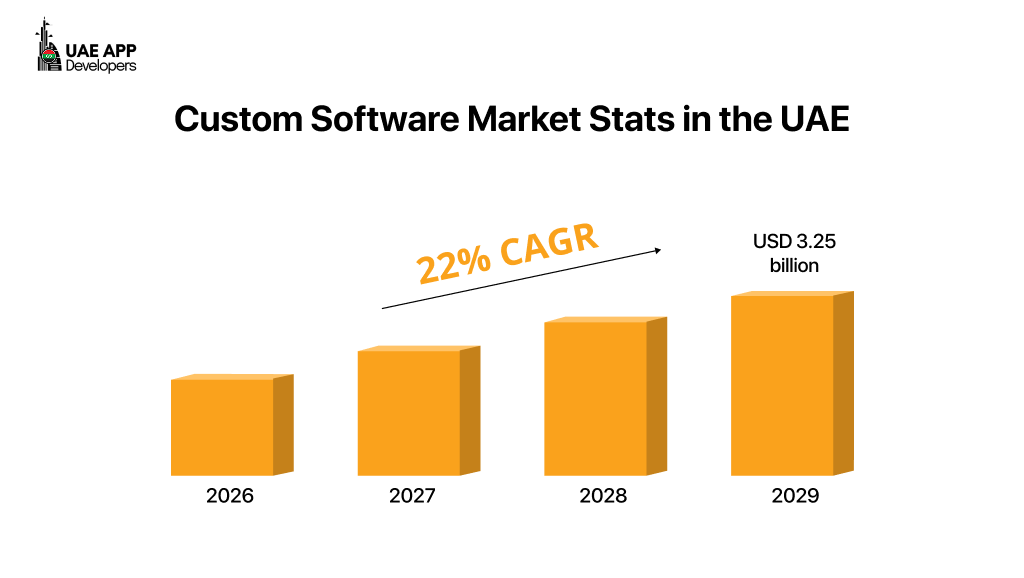
For your information, the software development cost in the UAE is no longer just a budgeting exercise; it’s a growth lever. With the custom software market projected to reach USD 3.25 billion by 2030, growing at a 22% CAGR, demand for top-tier development is accelerating across the Middle East, and so are the stakes behind every build decision.

custom software market stats UAE

Because what you invest today doesn’t just launch a product. It defines your time-to-market, your scalability, and your next round of ROI.

In this cost guide, we break down the cost to develop software in the United Arab Emirates and development strategies at each project stage. But first, why the UAE?

Why is the UAE a Strategic Location for Software Development? 

Why is the United Arab Emirates a strategic hub for software development? It comes down to three game-changing advantages.

1. Skilled Local Talent

The UAE’s developer and product ecosystem has matured in fintech, proptech, logistics, healthtech, and government-backed digital products. That creates teams who understand:

  • Performance at scale
  • Compliance-heavy environments
  • Multi-language UX
  • High transaction systems 

2. Government Digital Support 

In most countries, regulation slows development down. In the UAE, policy is designed to pull it forward. National digital strategies, smart city programs, and pro-startup regulatory frameworks like Dubai Agenda D33 create a rare environment where:

  • Enterprise customers are digitally ready
  • Governments are active buyers of technology
  • New business models get regulatory sandboxes 

3. Close to the GCC Market

The GCC is one of the highest-spending regions on digital transformation, but it is relationship-driven, trust-driven, and operationally complex. So, if your roadmap includes Saudi Arabia, Qatar, or the wider GCC, building from the UAE is a strategic distribution decision.

The UAE acts as:

  • A neutral headquarters
  • A logistics hub
  • A legal and financial bridge into the region

The growth tells you the UAE market; make your software with UAE app developers

Once the strategic case is clear, the next step is to break down the average software development pricing UAE.

How Much Does Software Development Cost in UAE?

The final price comes down to how complex your software needs to be. A simple MVP might start around AED 50,000, while a full-scale, enterprise-grade product can easily reach AED 400,000 or more.

The table below breaks down all three software development categories, including their cost ranges and the features you can expect in each.

Complexity Cost in AED Cost in USD Functionality
Basic/MVP Software AED 50,000–150,000+ $15,000–$40,000+
  • Core features
  • Basic User Interface (UI)
  • Basic CRUD operations
  • Local file saving
Medium-Level Software AED 150,000–250,000+ $40,000–$90,000+
  • Complex GUI with multiple menus
  • Database integration
  • User authentication
Advanced/Enterprise Software AED 250,000–400,000+ $90,000–$150,000+
  • AI-based analytics
  • Advanced Security
  • Cloud-based architecture
  • Microservices

What is the Development Cost by Software Type?

Different software categories create different economic outcomes. Some generate revenue. Some compress operational costs. Others become long-term infrastructure that determines how fast you can scale.

The development cost by software type directly maps to the ROI, speed, and scalability it enables. But the real question isn’t “How much does it cost?” It’s:

What does this software unlock for the business over the next 3–5 years?

Let’s break this down from a capital allocation and growth lens, not a pricing checklist.

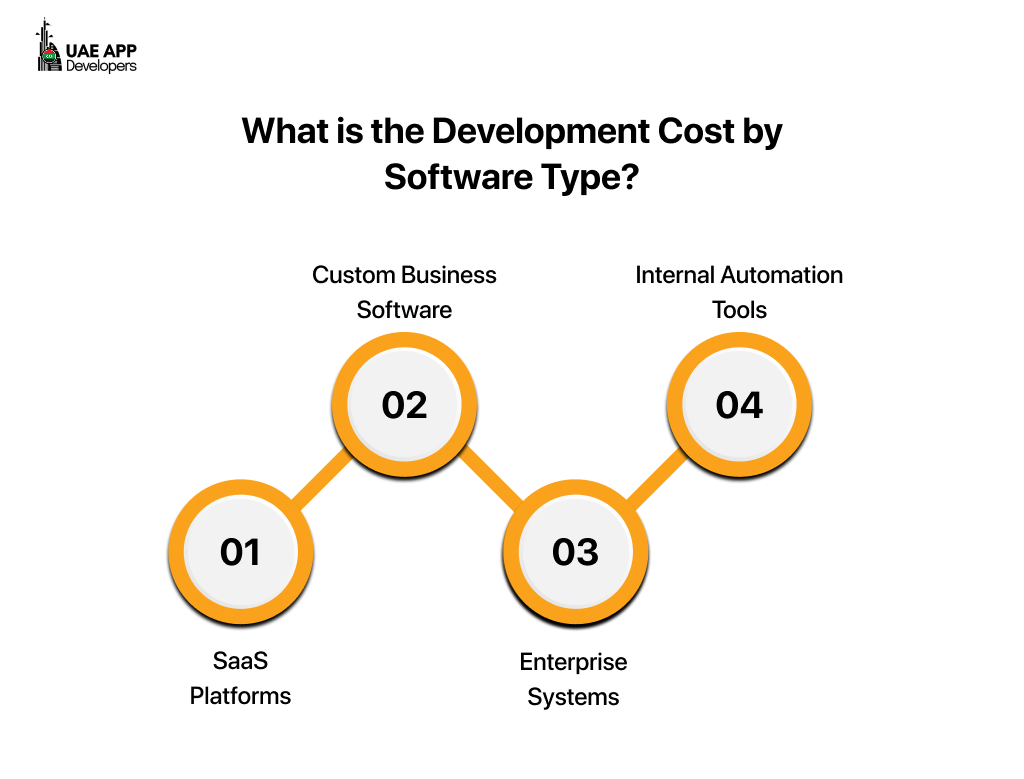
Development Cost by Software Type


1. SaaS Platforms

SaaS products are the only category where development cost directly maps to future valuation. For ROI logic, every dollar spent on SaaS development should answer one question:

‘Does this increase LTV/CAC efficiency?’

Don’t ever fall for the cheap SaaS builds; they don’t just break technically. They break your growth model.

SaaS Development Cost in UAE: AED 90,000-400,000+

2. Custom Business Software

If your business model is unique, custom software can serve as a strategic moat. It is expensive because it replaces generic workflows with your proprietary way of operating, and that’s exactly why it pays off.

Average Custom Software Development Cost UAE: AED 50,000–350,000+

3. Enterprise Systems

Enterprise software is about risk, compliance, and organizational velocity. At scale, inefficiency is expensive.

If 500 employees lose 20 minutes per day due to system friction, that’s not a UX issue; it’s a multi-million-dollar productivity leak.

Enterprise Software Development Cost UAE: AED 100,000-400,000+

4. Internal Automation Tools

This is the highest ROI per dollar spent category and the most underestimated. Automation is how modern companies grow without linear hiring.

With internal automation tools, the market rewards revenue growth. But internally, automation protects profitability.

Internal Automation Tools Cost: AED 150,000-500,000+

The table below shows all the differences between the above-given software types so that you can select one with ease. 

Software Type Primary Business Outcome Financial Impact
Custom Business Software Competitive differentiation Margin expansion
SaaS Platforms Recurring revenue & valuation Multiple expansion
Enterprise Systems Organizational scalability Cost control at scale
Internal Automation Tools Operational efficiency Immediate ROI


to know your business real cost use the UAE App Developers free guidance

The range is clear. Now, let’s break down the key factors that are driving the Software development cost in the Middle East. 

What are the Core Cost Drivers of Software development?

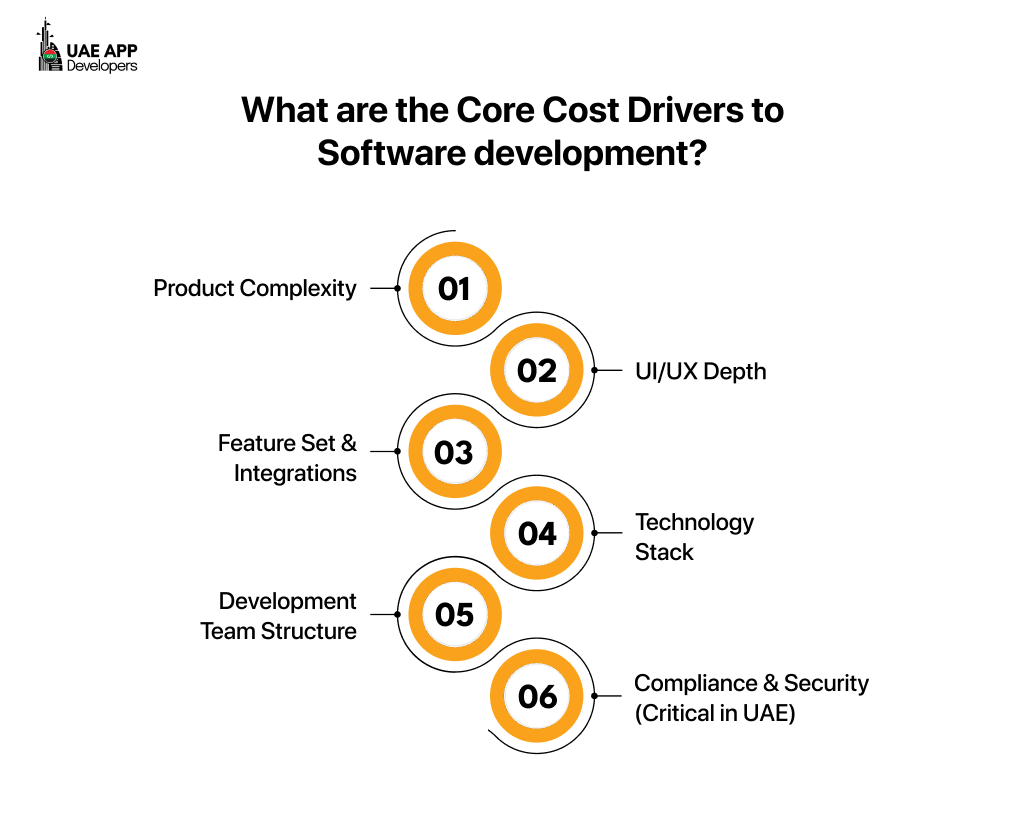
Several factors influence the cost of software development in the UAE. Let’s take a close look at them below.

Core Cost Drivers to develop a Software

➜ Product Complexity

Complexity is not about the number of screens. It’s about the number of moving parts in your business model.  

As an example, a marketplace with real-time pricing logic, multi-role dashboards, dynamic workflows, and analytics isn’t “just another software”. It’s a digital operating system.

Higher complexity will cost more, but the MVPs with core functions will cost you less. Complexity increases cost because it requires:

  • Scalable architecture from day one
  • Advanced database design
  • Performance engineering
  • Higher testing depth

Cost: AED 8,000–15,000+

➜ UI/UX Depth

UAE users are high-expectation, mobile-first, and experience-driven. That shifts UI/UX from “visual layer” to conversion infrastructure. And that’s why interface design is one of the factors that influence the software architecture cost.

Deeper UX work includes:

  • Behavioral flow optimization
  • Multi-language experience (Arabic + English)
  • Design systems for rapid feature rollout
  • Micro-interactions that build trust in fintech, healthtech, and commerce

Cost: AED 10,000-20,000+

➜ Feature Set & Integrations

The feature isn’t expensive. The ecosystem around the feature is. Every integration, like payment gateways, logistics APIs, ERP systems, CRMs, and government platforms, introduces: 

  • Dependency risk
  • Testing complexity
  • Ongoing maintenance load
In the UAE, Integrations Often Include:
  • Local payment ecosystems
  • VAT-compliant billing systems
  • Enterprise middleware
  • Real-time data sync with operational tools

Cost: AED 12,000-30,000+

➜ Technology Stack

Your chosen technology stack for your software decides the speed, control, and accuracy of the final product. Below is an overview of every tech layer and the latest technology stack with cost implications you can use in Software development.

Tech Layer Technology Cost Implications
Frontend React, Angular, Vue Moderate–High, depending on developer availability
Backend Node.js, Python/Django, Java/Spring Node.js: faster iteration
Java: higher initial cost
Database PostgreSQL, MySQL, MongoDB SQL options moderate
NoSQL varies with scale
Cloud/Hosting AWS, Azure, GCP Pay-as-you-go, cloud choice affects monthly OPEX


Cost: AED 10,000-30,000+

➜ Development Team Structure

This is one of the biggest and most misunderstood factors that impact the cost of software development.

Your cost changes dramatically depending on whether you choose an in-house team, Project-based outsourcing, or a dedicated product team.

But the real variable is not location. It’s product ownership. Below in the table, you will get to know the software development hourly rate UAE.

Development Team Type Cost in AED Cost in USD
In-house team AED 250–500/hr+ $60–$100/hr+
Project-based outsourcing AED 200–400/hr+ $50–$90/hr+
Dedicated product team AED 250–550/hr+ $80–$150/hr+

➜ Compliance & Security (Critical in UAE)

This is not an optional layer in the UAE. It’s a market entry requirement. Compliance and security shape architecture, hosting, and enterprise readiness from day one. 

The Federal Personal Data Protection Law (PDPL, Federal Decree-Law No. 45 of 2021) applies to any organization processing personal data. So you have to align with that, too. 

In the UAE, security maturity is often a prerequisite for scale; this is also a fact that affects the total cost. 

Cost: AED 10,000-15,000+

These factors shape the budget. The development stages decide how that budget is deployed.

How Much Does Software Development Cost by Project Stage? Step-by-Step

When starting to develop software in the United Arab Emirates, you should also know how much the development process costs you. 

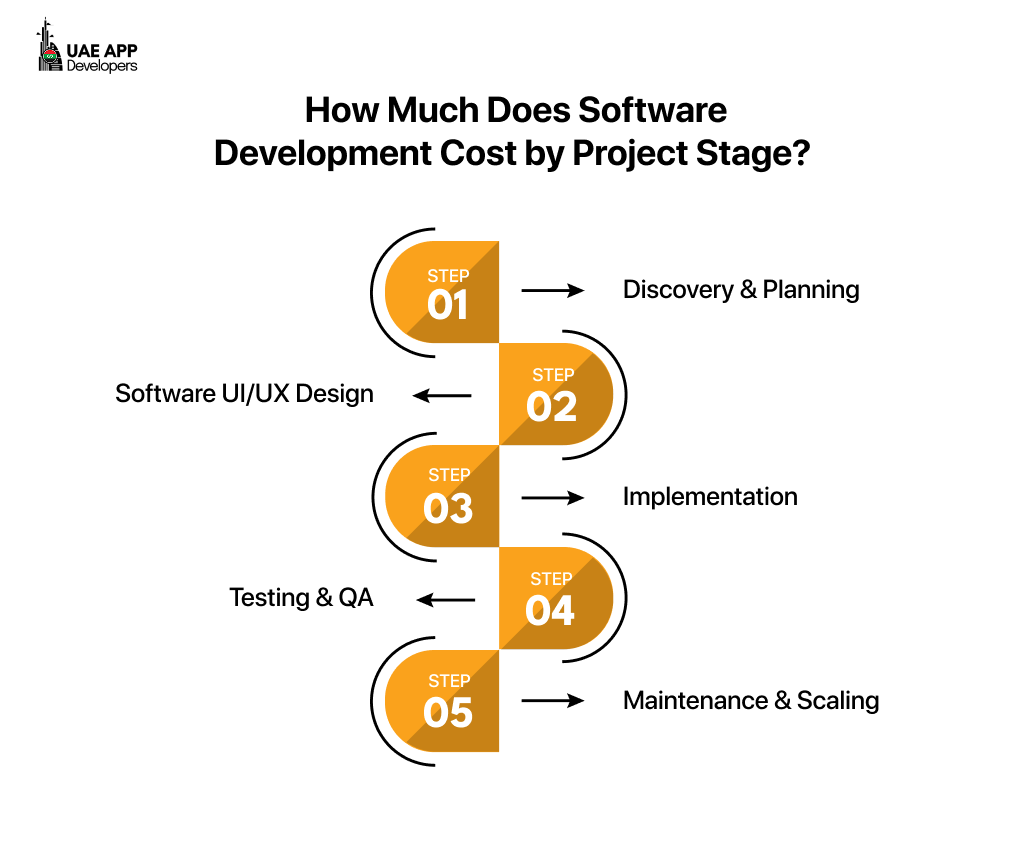
Software Development Cost by Project Stage

Step 1: Discovery & Planning

Most companies still underestimate this phase because it doesn’t produce visible features. You need clarity and solid planning of your vision. You should ask and answer these questions: 

  1. What problem will the software solve? 
  2. Build an MVP or full-scale first.
  3. Market validation across multilingual, multicultural user bases
The research and planning stage typically consumes 5–10% of the total development budget.

Step 2: Software UI/UX Design

The software’s interface should represent a smooth, clean user journey. Basically, in the UAE’s digital economy, UI/UX design is not about aesthetics. It directly affects conversion rates, customer trust, retention, and brand positioning in a premium market. 

This phase usually takes 15–20% of the total budget.

Step 3: Implementation 

This phase defines your future feature velocity. A cheap build slows product iteration, which slows revenue experiments. This is where most of the visible budget sits and where most leadership teams focus too narrowly on hourly rates.

The implementation stage takes 40–45% of the total budget.

Step 4: Testing & QA

In emerging markets, QA is often seen as a buffer before launch. In the UAE, it’s a brand risk function. You’re operating in a region where users expect flawless payments, real-time performance, and secure data handling. 

This stage of the software development takes 10-15% of the total budget.

Step 5: Maintenance & Scaling

If your plan is growth, maintenance is not a support retainer. It’s your innovation budget. This is where the financial model shifts from project to product

This stage typically includes performance optimization, feature expansion, Infrastructure scaling, security updates, analytics & product iteration.

This will take 5-10% from your total software development cost in UAE.

Understanding the cost by stage explains the money flow. Choosing the right team model determines the control, velocity, and long-term ROI of that spend.

In-House vs Outsourcing vs Dedicated Teams in the UAE

To calculate the average rate of software developers in Dubai (Any Type), you can use this formula:

Total development cost: Development Rate x Hourly rate of developers + Factors like UI/UX, APIs, and others. 

Here’s a comparison of the cost to hire software developers in UAE.

Comparison In-House Team Outsourcing Teams Dedicated Teams
Cost AED 100,000–300,000+ AED 60,000–200,000+ AED 150,000–400,000+
Speed Takes time to hire and set up Quickest way to get things done Fast start: the team is already ready to work on your project
Control Full control Limited control: the vendor decides some things You have control over work and priorities while they manage operations
Long-Term ROI Great if you plan to grow your product long-term Not ideal for scaling, best for one-off projects Strong ROI; scales with your product without huge overhead
Best Fit For Big companies or startups with a long-term vision Small projects, MVPs, or tight budgets Growing startups or businesses ready to scale quickly


After selecting the right development model, the focus shifts from who builds your product to how efficiently you build it.

How to Reduce Software Development Cost in the UAE?

Reduce the cost of software development in UAE with these proven, practical strategies.

1. MVP-first Approach

Don’t guess what users want. Let real users show you. Early feedback prevents costly rewrites. It helps you spot features that aren’t needed yet. An MVP lets you test market fit without burning millions. You learn fast, invest smartly, and make decisions backed by real data.

2. Prioritised Feature Architecture

Founders often spend 30–40% of their early budget on features that don’t matter. Cutting these out saves money and speeds delivery. Use frameworks like RICE or MoSCoW. Or just ask: “Will this feature increase revenue or retention?” If no, skip it for now.

3. Scalable Tech Decisions Early

A scalable setup might cost a little more upfront. But it prevents headaches later. Updates, integrations, or traffic spikes become manageable. Going cheap on tech now feels smart. But it often costs more later. A rushed framework or messy code leads to expensive rewrites.

4. Dedicated Team Model

Switching freelancers costs time. Knowledge gets lost. Dedicated teams know your product. They move fast. Teams that know your product can spot inefficiencies before they become problems. They optimize features & reduce bugs.

End Summary

In the UAE, software isn’t a line item; it’s the engine behind how fast you launch, how well you scale, and how confidently you raise your next round. Once you see where the money goes and what it unlocks, the conversation shifts from cost to control.

If you’re comparing software development services in the UAE, it helps to speak with a team that looks at your roadmap through a product and ROI lens. That’s where UAE App Developers, a trusted software development company, Dubai, stands out:

  • Product-first thinking, not hourly billing logic
  • Dedicated teams that grow with your platform
  • Strong grip on UAE compliance and enterprise-ready builds
  • Scalable architecture that protects long-term cost
  • Clear delivery, real visibility, faster decisions

If your next step is turning estimates into a real build strategy, this is a good place to start the conversation.

have a conversation with UAE App Developers to create a custom software for your business

Mobile App Development Cost in UAE: The Complete Budget Guide

Last month, a founder in Dubai said that he had two versions of the same app idea. One was built fast and cheap. The other was planned to scale. 

The difference was in cost and in investor interest.

That’s how the mobile app development cost in the UAE conversation usually starts. Not with code, but with decisions. 

How serious is the product? How fast do you want to launch? Are you building for testing or for the market?

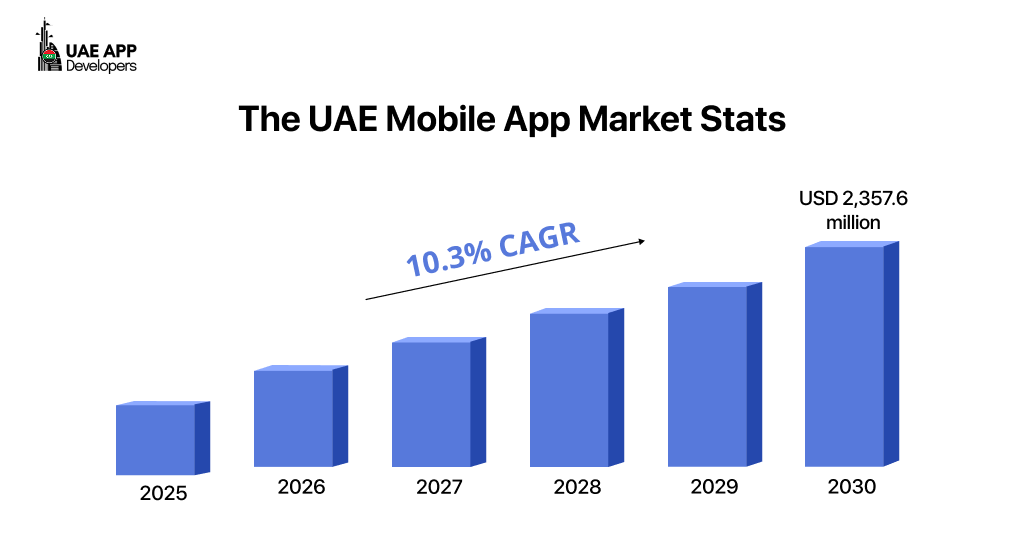
And this question is getting more relevant every year. The UAE mobile app market is expected to reach USD 2,357.6 million by 2030, growing at a 10.3% CAGR from 2026 to 2030. More funding is flowing. More apps are going live. The bar for quality is higher than ever.

The UAE app market Statistics

So when someone asks how much does it cost to build an app in the United Arab Emirates, they’re really asking something deeper. 

In this blog, you will get to know what it costs to build an app that can compete, scale, and actually deliver returns in this market. But first, why invest in an app in the UAE?

3 Reasons Why Invest in the UAE App Market

This is a market where people download fast, spend more, and are always ready for the next digital experience. Look at 3 reasons why you should invest in the UAE app market. 

1. Easy Access to the International Market

The UAE isn’t just a local hub; it’s a global bridge. Building an app here allows you to test your product in one of the most diverse demographic pools in the world. If it works here, you’ve got a blueprint that can scale from London to Mumbai.

2. Strong Government Support 

From the Dubai Economic Agenda (D33) to the Smart Abu Dhabi push, the message is clear: digital comes first. The ecosystem actively backs innovation. Founders get access to grants. Licensing is faster and less complicated. 

Regulations are built for digital businesses, not against them. If you’re building something tech-driven, you’re stepping into a system designed to support you.

3. High Revenue Potential 

This is a market where smartphone penetration is almost 100%. People aren’t just casually browsing. They come with intent and strong buying power. They expect smooth, premium digital experiences as a standard. And if the experience feels right, they don’t hesitate to pay for it.

All of that sounds promising, but the real question founders ask at this point is simple: what’s the cost to build an application and everything that it takes to build in this market?”

How Much Does it Cost to Develop an App in the UAE?

The mobile app development cost in the United Arab Emirates varies wildly depending on the complexity and features you want in the app. 

The average cost range to build an app in Dubai, UAE, is around AED 30,000 to AED 400,000+ (USD $10,000-$150,000+). 

Based on current 2026 projections, here is how the UAE app development pricing typically breaks down:

App type Cost in AED Cost in USD Functions
Simple/Basic AED 30,000-80,000+ $10,000-$30,000+ Basic UI, email login, simple profile
Medium Complexity AED 80,000-200,000+ $30,000-$90,000+ API integrations, payment gateways, custom UI
Enterprise/Complex AED 200,000-400,000+ $90,000-$150,000+ AI features, multi-language, advanced security

App Development Process: Cost breakdown

Here’s a realistic cost breakdown for each stage of the app development process in the UAE (2026).

  • Research & planning: AED 5,000-20,000
  • Platform selection: AED 2,000-8,000
  • UI/UX designing: AED 10,000-20,000 (basic to mid)
  • Development tech stack: AED 5,000-15,000
  • Coding development: AED 12,000-30,000
  • Testing and QA: AED 8,000-12,000
  • Launching the app: AED 5,000-15,000
  • Maintenance & Support: AED 20,000-100,000+/year

Basic MVP vs. Full-Scale App Development

The biggest mistake the founders make is that they try to build the “Titanic” before testing the water. Let’s find the difference between MVP and full-scale development before understanding what factors influence the cost to make an app. 

Comparison MVP (Minimum Viable Product) Full-Scale Development
Goal Test market viability with core features Provide a comprehensive user experience
Timeline 2–4 months 6–12+ months
Cost AED 30,000-90,000+ AED 200,000-400,000+
Flexibility High; easy to pivot based on feedback Lower requires extensive updates to change
CTA: develop an app with UAE App Developers
Once the scope is clear, the conversation naturally shifts from ‘how much’ to ‘what exactly is driving the cost’.

What Factors Impact Mobile App Development Cost in the UAE?

The cost of mobile app development isn’t just about the number of screens. Several factors drive the mobile app development cost.

✔ Features and Functions 

A simple MVP with a tight core loop is cheaper because it’s focused. A feature-heavy product is expensive because it’s trying to solve scale before proving demand.

Key Cost Drivers
  • Real-time functionality (chat, tracking, live updates)
  • AI or recommendation engines
  • Payment architecture
  • Multi-role dashboards
  • Third-party integrations

From a SaaS and product lens, the question isn’t “What will this feature cost?” It’s “What revenue or growth lever does this unlock?”  

Cost: AED 12,000-18,000 (USD $5,000-$10,000)

✔ Platform Selection

Choosing between iOS, Android, or cross-platform isn’t a technical decision; it’s a distribution strategy. A seasoned mobile app development company will frame this as a capital allocation decision, not a tech preference.

Because the real question is: Do you need to reach fast or depth first?

Native development increases upfront cost, but it delivers
  • Higher performance
  • Better platform-specific UX
  • Stronger enterprise perception
Cross-platform reduces initial investment and accelerates launch timelines, which is critical when
  • You’re validating product–market fit
  • You’re entering a competitive category
  • You’re operating under funding constraints
Cost: AED 8,000-10,000 (USD $2,000-$4,000)

✔ UI/UX Interface Design 

Great UI/UX design is often seen as a “design expense”. In reality, it’s a revenue multiplier. Poor UX is expensive. It increases churn, slows onboarding, and forces you to compensate with marketing spend. 

The right design reduces rebuilds, accelerates development cycles, and keeps CAC under control.

Where design directly impacts
  • Activation rate
  • Retention curves
  • Support costs
  • Time-to-value
High-performance product teams invest early in
  • User flow architecture
  • Behavioral design
  • Scalable design systems
Cost: AED 10,000-15,000 (USD $4,000-$6,000)

✔ RTL (Right-to-Left) Arabic Layouts

Supporting Arabic is not a simple text translation. It changes how the entire interface behaves. 

In an RTL environment, everything flips. Navigation shifts to the right. Progress indicators run in the opposite direction. Icons that suggest movement or flow need alternate versions. Even animations and gesture logic must feel native to right-to-left users.

In the UAE and across the GCC, this isn’t an optional feature. An app that doesn’t feel native in Arabic signals that the product wasn’t built for the market. So it’s not optional.

Cost: AED 6,000-8,000 (USD $2,000-$3,000)

✔ Government Rules and Regulations

Most founders underestimate how deeply regulation shapes product architecture, rollout speed, and even the business model itself.

The UAE’s Personal Data Protection Law (PDPL) affects:

  • Where is user data stored?
  • How is consent captured?
  • How are analytics tools implemented?
  • Cross-border data transfers

This is why experienced development teams align the product roadmap with the license activity, not the other way around.

That has a direct impact on burn and time-to-revenue.

Cost: AED 6,000-8,000 (USD $2,000-$3,000)

✔ Development Team Location and Expertise 

The cost of hiring a mobile app development company varies widely by geography, but the real difference is in product thinking.

Lower hourly rates can increase total cost if the team executes without challenging assumptions, lacks scalability experience, and requires heavy management.

Team Location Cost in AED Cost in USD
UAE (Middle East) AED 100-150/hr $25-$100/hr
USA AED 150-200/hr $50-$150/hr
Europe AED 180-250/hr $50-$200/hr

✔ Compliance and Security 

As soon as you introduce payments, user data, enterprise clients, and multi-tenant SaaS models, security becomes part of your value proposition.

Investment here impacts:

  • Enterprise deal closures
  • App store approvals
  • Brand credibility
  • Expansion into regulated markets

In other words, it’s directly tied to revenue access.

Cost: AED 9,000-12,000 (USD $5,000-$8,000)

✔ Ongoing Maintenance and Support 

After the launch, ongoing maintenance also impacts the cost to develop your app. Regular updates, bug fixes, and customer support really drive the app development budget. 

Application maintenance includes: 

  • Performance optimization
  • OS compatibility updates
  • Feature iteration
  • Analytics-driven improvements
Cost: AED 90-150/hr (USD $50-$100/hr)

So, how do these investments translate into an actual build journey? Let’s walk through what the development path looks like in the UAE.

How to Create a Mobile App in the UAE: Step-by-Step Process 

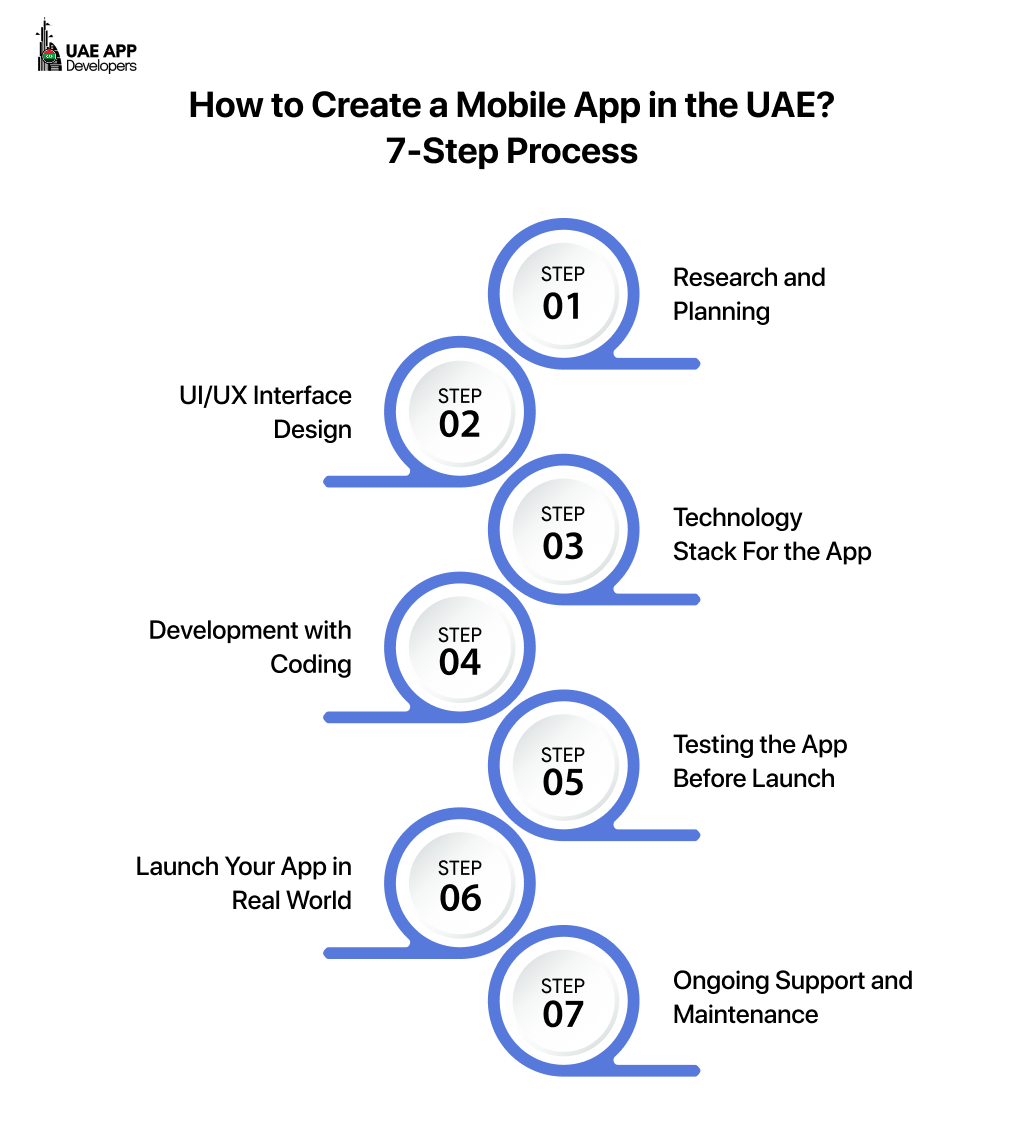
From concept to launch, building a mobile app in the Middle East follows a clear path if you know where to start. Here’s a 7-step guide to building a mobile app in the United Arab Emirates. 

7 step process to build an app in UAE

Step 1: Research and Planning 

Before a single screen is designed, serious teams pressure-test the commercial logic.

  • Who is the user in the UAE context?
  • What is their purchasing behavior?
  • Is this a convenience play, a marketplace, a retention product, or a new revenue channel?

The region has high digital adoption and strong spending power, but that doesn’t guarantee product-market fit. It rewards apps that solve a clear, frequent problem.

Step 2: UI/UX Interface Design

In the UAE, design is not a cosmetic layer; it’s a trust signal. This stage is about translating business logic into user flows that feel effortless.

Users here compare your app with global products daily. If the experience feels slow, cluttered, or outdated, churn happens fast, no matter how strong the backend is.

Good UI/UX decisions reduce customer acquisition cost, support queries, and drop-off rates

Step 3: Technology Stack For the App  

Your chosen tech stack decides how fast you can launch your app and how easily your app can scale in the real world. This is why the “how to develop an app in the UAE” conversation is often a build-vs-scale discussion.

App Layer Technology
Backend Node.js, Python, .NET, PHP
Frontend AFlutter, react native, Swift, kotlin
Database PostgreSQL, MySQL, MongoDB, Firebase Firestore
Cloud AWS, Microsoft Azure, Google Cloud Platform
APIs REST, GraphQL, gRPC

Step 4: Development with Coding 

Teams that validated features early move faster because they’re not rebuilding mid-sprint. The focus stays on clean architecture, modular development, and milestone-based releases. 

  • Backend Development:  The backend handles API integration, real-time systems, payments, admin controls, and security.
  • Frontend Development: It handles screen layouts, buttons, animations, and local light storage. 

Step 5: Testing the App Before Launch  

In a high-expectation market like the UAE, performance issues are not tolerated for long. Every bug that reaches production increases acquisition costs, refund risk, negative reviews, and brand damage. 

Test before launching the app: 

  • Real device environments
  • User flow friction
  • Load conditions

Step 6: Launch Your App in Real World

This is where many first-time founders lose momentum. They invest in development but underinvest in launch strategy. Launching is not uploading your app to the app stores. It’s aligning the product with a user acquisition plan, analytics, and feedback loops.

Here are the steps to launch your app: 

  1. Create attractive and engaging app titles, descriptions, and screenshots
  2. Submit your app to the App Store and Google Play Store. 
  3. Set up the analytic tools to monitor key performance. 

Step 7: Ongoing Support and Maintenance

The most successful teams treat launch as the starting line. Because the real value of an app isn’t in downloads, it’s in lifetime customer value. And that only grows when the product keeps improving.

Post-launch focus typically moves to:

  • Performance optimization
  • Feature iteration based on user data
  • Retention mechanics

CTA: build an app with UAE app developers

With the build path mapped, the more strategic question becomes: where is the market momentum actually heading?

What Are the Growing App Categories in the Middle East?

If you’re looking for where the “smart money” is moving, keep an eye on these app categories that are growing at a rapid pace:

1. Super Apps (All-In-One)

Instead of building separate platforms for transport, payments, commerce, and services, companies are consolidating user journeys into one ecosystem. 

Super apps in this region are solving a structural business problem: customer acquisition cost.

In markets where users are comfortable managing multiple services inside a single interface, the super app model turns distribution into a defensible advantage.

Cost to Develop a Super App: AED 400,000 to AED 1,000,000 (USD $150,000–$300,000+)

2. Fintech and Digital Wallet 

Fintech app development growth in the Middle East is being driven by policy support, digital-first consumers, and the shift away from cash. 

The real opportunity lies in embedding financial services into existing platforms. Payments reduce friction, but financial data creates valuation.

Fintech App Development Cost: AED 35,000–200,000 (USD $10,000-$120,000)

3. E-commerce and Retail 

The e-commerce race here is no longer about “going online”. That phase is over. Now the battle is last-mile efficiency, personalized shopping, and retention. 

This is where conversations around E-commerce app development costs become strategic. Founders aren’t just budgeting for a shopfront; they’re investing in logistics integration, AI-driven recommendations, and post-purchase engagement.

Because in this market, the brands that control the customer experience control the margin.

E-commerce & Retail App Development Cost: AED 50,000–250,000 (USD $15,000-$150,000)

4. AI-Driven Applications

AI adoption in the region is moving straight to implementation. Companies are using it to automate operations, personalize user journeys, predict demand, and reduce support costs. Apps that use AI well improve unit economics, and that’s what attracts serious capital.

AI-Powered App Development Cost: AED 100,000–300,000 (USD $20,000-$200,000)

5. Gaming: Underrated Revenue Engine

Gaming is often misunderstood as an entertainment category. In reality, it’s one of the most advanced monetization models in the app economy. 

The Middle East has:

  • A young, mobile-first population
  • High in-app purchase potential
  • Strong engagement time

Which makes gaming app development a high-retention, high-LTV opportunity.

Gaming App Development Cost: AED 70,000–220,000 (USD $20,000-$150,000)

6. Healthtech and Telemedicine 

It’s one of the few categories where strong UX directly improves operational efficiency for entire institutions. Healthcare in the region is going through a digital acceleration phase, and the winners are platforms that reduce friction for both patients and providers. 

The commercial value of healthcare app development comes from recurring consultations, integrated diagnostics, and subscription-based care models.

Medtech App Development Cost: AED 80,000–250,000 (USD $25,000-$200,000)

Final Words 

In the end, the cost conversation is really a product conversation. What you build, how you build it, and who builds it will decide how fast you reach the market and how long you stay there. In a place like the UAE, where users expect polished experiences and investors look for scale, shortcuts rarely pay off.

That’s why founders looking for mobile app development services or a dependable mobile app development company in Dubai usually focus less on hourly rates and more on product thinking. The right team, like ‘UAE app developers’, doesn’t just ship features. They shape outcomes.

Why UAE App Developers is a strong choice:

  • They approach every build with a clear product and revenue lens
  • Experience with scalable, UAE-ready app architectures
  • Clean execution that avoids costly rebuilds later
  • Strong grip on compliance, performance, and store approvals
  • Post-launch support that keeps the app moving with user data

If your app idea has moved beyond the “what if” stage, this is the moment to sit down with people who can map the right build path for your budget and your market.

Let's make the next scalable app in UAE with UAE app developers

PRJECT IN MIND?

Let’s Connect! Reach Out Anytime!

We’re here to help! Reach out to us anytime and let’s connect to discuss your needs, answer questions, and explore opportunities together.

UAE

One Central, The offices 3, Level 3, DWTC, Sheikh Zayed Road, Dubai, UAE

+971 (0) 507821690

Say Hello