Digital Transformation Cost in Dubai, UAE: Full 2026 Budget Guide
1394 Views 9 min March 3, 2026

Last month, a founder in Dubai said that he had two versions of the same app idea. One was built fast and cheap. The other was planned to scale.
The difference was in cost and in investor interest.
That’s how the mobile app development cost in the UAE conversation usually starts. Not with code, but with decisions.
How serious is the product? How fast do you want to launch? Are you building for testing or for the market?
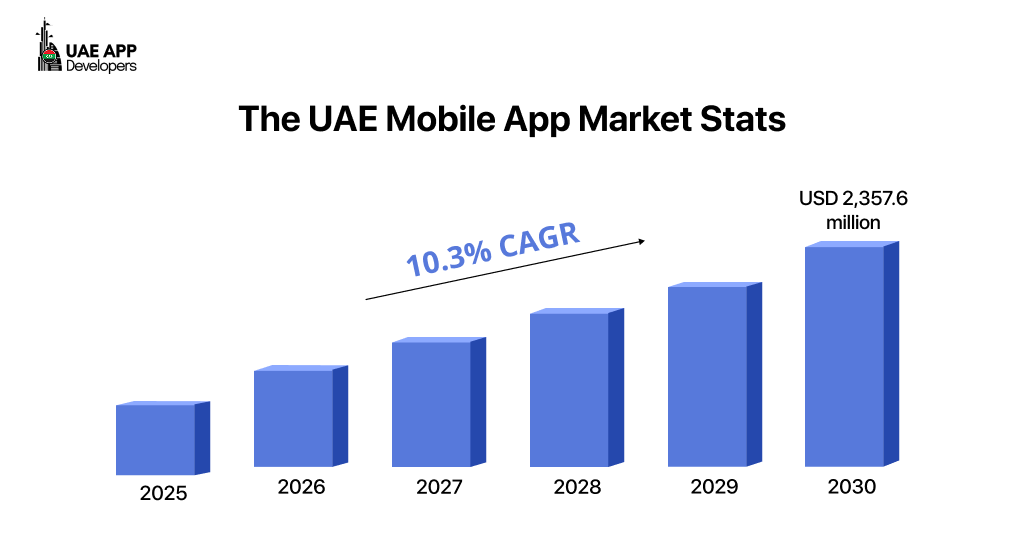
And this question is getting more relevant every year. The UAE mobile app market is expected to reach USD 2,357.6 million by 2030, growing at a 10.3% CAGR from 2026 to 2030. More funding is flowing. More apps are going live. The bar for quality is higher than ever.
So when someone asks how much does it cost to build an app in the United Arab Emirates, they’re really asking something deeper.
In this blog, you will get to know what it costs to build an app that can compete, scale, and actually deliver returns in this market. But first, why invest in an app in the UAE?
This is a market where people download fast, spend more, and are always ready for the next digital experience. Look at 3 reasons why you should invest in the UAE app market.
The UAE isn't just a local hub; it’s a global bridge. Building an app here allows you to test your product in one of the most diverse demographic pools in the world. If it works here, you’ve got a blueprint that can scale from London to Mumbai.
From the Dubai Economic Agenda (D33) to the Smart Abu Dhabi push, the message is clear: digital comes first. The ecosystem actively backs innovation. Founders get access to grants. Licensing is faster and less complicated.
Regulations are built for digital businesses, not against them. If you’re building something tech-driven, you’re stepping into a system designed to support you.
This is a market where smartphone penetration is almost 100%. People aren’t just casually browsing. They come with intent and strong buying power. They expect smooth, premium digital experiences as a standard. And if the experience feels right, they don’t hesitate to pay for it.
All of that sounds promising, but the real question founders ask at this point is simple: what’s the cost to build an application and everything that it takes to build in this market?”
The mobile app development cost in the United Arab Emirates varies wildly depending on the complexity and features you want in the app.
The average cost range to build an app in Dubai, UAE, is around AED 30,000 to AED 400,000+ (USD $10,000-$150,000+).
Based on current 2026 projections, here is how the UAE app development pricing typically breaks down:
| App type | Cost in AED | Cost in USD | Functions |
|---|---|---|---|
| Simple/Basic | AED 30,000-80,000+ | $10,000-$30,000+ | Basic UI, email login, simple profile |
| Medium Complexity | AED 80,000-200,000+ | $30,000-$90,000+ | API integrations, payment gateways, custom UI |
| Enterprise/Complex | AED 200,000-400,000+ | $90,000-$150,000+ | AI features, multi-language, advanced security |
Here’s a realistic cost breakdown for each stage of the app development process in the UAE (2026).
The biggest mistake the founders make is that they try to build the "Titanic" before testing the water. Let’s find the difference between MVP and full-scale development before understanding what factors influence the cost to make an app.
| Comparison | MVP (Minimum Viable Product) | Full-Scale Development |
|---|---|---|
| Goal | Test market viability with core features | Provide a comprehensive user experience |
| Timeline | 2–4 months | 6–12+ months |
| Cost | AED 30,000-90,000+ | AED 200,000-400,000+ |
| Flexibility | High; easy to pivot based on feedback | Lower requires extensive updates to change |
The cost of mobile app development isn't just about the number of screens. Several factors drive the mobile app development cost.
A simple MVP with a tight core loop is cheaper because it’s focused. A feature-heavy product is expensive because it’s trying to solve scale before proving demand.
| Key Cost Drivers |
|
|---|
From a SaaS and product lens, the question isn’t “What will this feature cost?” It’s “What revenue or growth lever does this unlock?”
| Cost: AED 12,000-18,000 (USD $5,000-$10,000) |
|---|
Choosing between iOS, Android, or cross-platform isn’t a technical decision; it’s a distribution strategy. A seasoned mobile app development company will frame this as a capital allocation decision, not a tech preference.
Because the real question is: Do you need to reach fast or depth first?
| Native development increases upfront cost, but it delivers |
|
|---|---|
| Cross-platform reduces initial investment and accelerates launch timelines, which is critical when |
|
| Cost: AED 8,000-10,000 (USD $2,000-$4,000) |
|---|
Great UI/UX design is often seen as a “design expense". In reality, it’s a revenue multiplier. Poor UX is expensive. It increases churn, slows onboarding, and forces you to compensate with marketing spend.
The right design reduces rebuilds, accelerates development cycles, and keeps CAC under control.
| Where design directly impacts |
|
|---|---|
| High-performance product teams invest early in |
|
| Cost: AED 10,000-15,000 (USD $4,000-$6,000) |
|---|
Supporting Arabic is not a simple text translation. It changes how the entire interface behaves.
In an RTL environment, everything flips. Navigation shifts to the right. Progress indicators run in the opposite direction. Icons that suggest movement or flow need alternate versions. Even animations and gesture logic must feel native to right-to-left users.
In the UAE and across the GCC, this isn’t an optional feature. An app that doesn’t feel native in Arabic signals that the product wasn’t built for the market. So it's not optional.
| Cost: AED 6,000-8,000 (USD $2,000-$3,000) |
|---|
Most founders underestimate how deeply regulation shapes product architecture, rollout speed, and even the business model itself.
The UAE’s Personal Data Protection Law (PDPL) affects:
This is why experienced development teams align the product roadmap with the license activity, not the other way around.
That has a direct impact on burn and time-to-revenue.
| Cost: AED 6,000-8,000 (USD $2,000-$3,000) |
|---|
The cost of hiring a mobile app development company varies widely by geography, but the real difference is in product thinking.
Lower hourly rates can increase total cost if the team executes without challenging assumptions, lacks scalability experience, and requires heavy management.
| Team Location | Cost in AED | Cost in USD |
|---|---|---|
| UAE (Middle East) | AED 100-150/hr | $25-$100/hr |
| USA | AED 150-200/hr | $50-$150/hr |
| Europe | AED 180-250/hr | $50-$200/hr |
As soon as you introduce payments, user data, enterprise clients, and multi-tenant SaaS models, security becomes part of your value proposition.
Investment here impacts:
In other words, it’s directly tied to revenue access.
| Cost: AED 9,000-12,000 (USD $5,000-$8,000) |
|---|
After the launch, ongoing maintenance also impacts the cost to develop your app. Regular updates, bug fixes, and customer support really drive the app development budget.
Application maintenance includes:
| Cost: AED 90-150/hr (USD $50-$100/hr) |
|---|
So, how do these investments translate into an actual build journey? Let’s walk through what the development path looks like in the UAE.
From concept to launch, building a mobile app in the Middle East follows a clear path if you know where to start. Here’s a 7-step guide to building a mobile app in the United Arab Emirates.
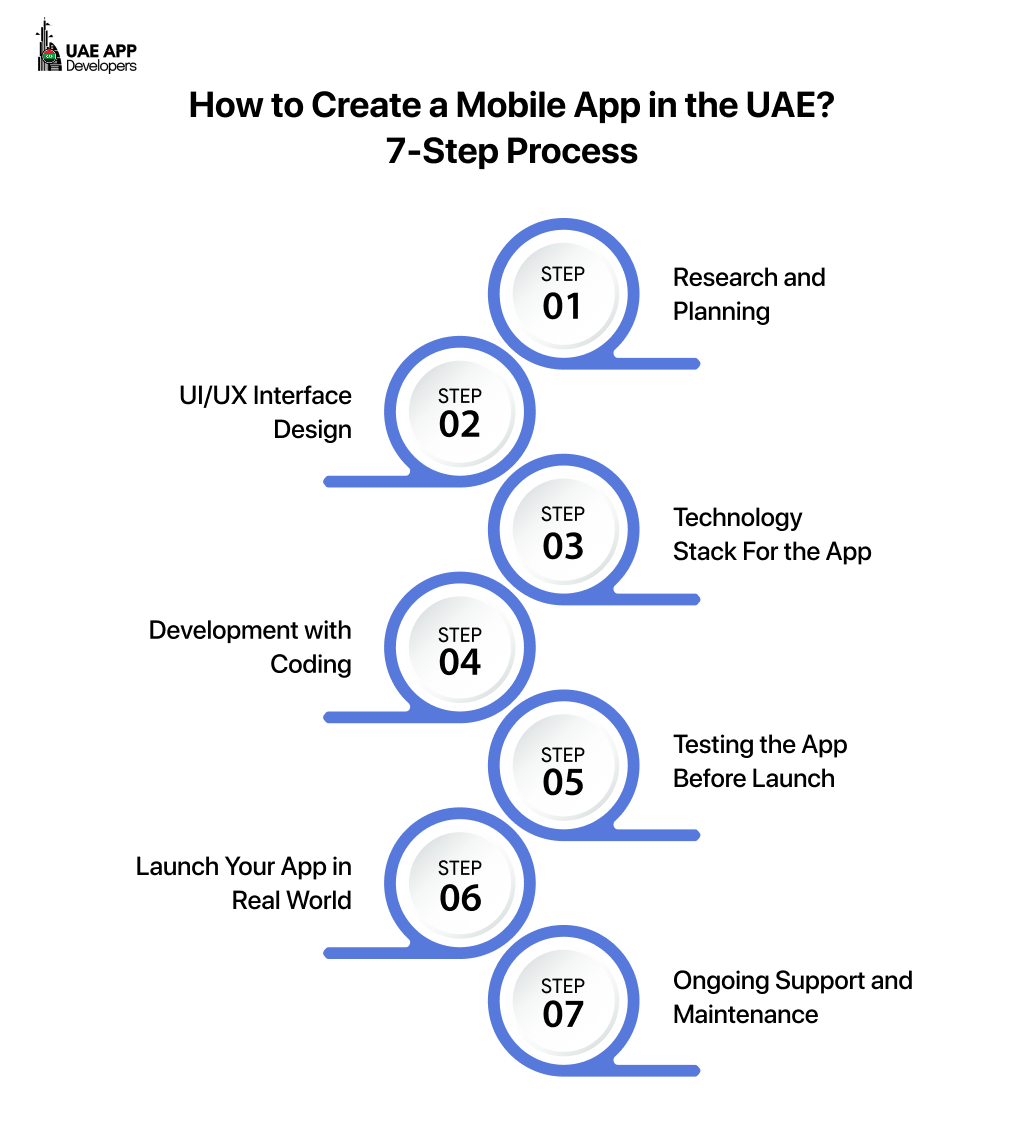
Step 1: Research and Planning Before a single screen is designed, serious teams pressure-test the commercial logic.
The region has high digital adoption and strong spending power, but that doesn’t guarantee product-market fit. It rewards apps that solve a clear, frequent problem.
Step 2: UI/UX Interface DesignIn the UAE, design is not a cosmetic layer; it’s a trust signal. This stage is about translating business logic into user flows that feel effortless.
Users here compare your app with global products daily. If the experience feels slow, cluttered, or outdated, churn happens fast, no matter how strong the backend is.
Good UI/UX decisions reduce customer acquisition cost, support queries, and drop-off rates
Step 3: Technology Stack For the App Your chosen tech stack decides how fast you can launch your app and how easily your app can scale in the real world. This is why the “how to develop an app in the UAE” conversation is often a build-vs-scale discussion.
| App Layer | Technology |
|---|---|
| Backend | Node.js, Python, .NET, PHP |
| Frontend | AFlutter, react native, Swift, kotlin |
| Database | PostgreSQL, MySQL, MongoDB, Firebase Firestore |
| Cloud | AWS, Microsoft Azure, Google Cloud Platform |
| APIs | REST, GraphQL, gRPC |
Step 4: Development with Coding Teams that validated features early move faster because they’re not rebuilding mid-sprint. The focus stays on clean architecture, modular development, and milestone-based releases.
Step 5: Testing the App Before Launch In a high-expectation market like the UAE, performance issues are not tolerated for long. Every bug that reaches production increases acquisition costs, refund risk, negative reviews, and brand damage.
Test before launching the app:
Step 6: Launch Your App in Real WorldThis is where many first-time founders lose momentum. They invest in development but underinvest in launch strategy. Launching is not uploading your app to the app stores. It’s aligning the product with a user acquisition plan, analytics, and feedback loops.
Here are the steps to launch your app:
Step 7: Ongoing Support and MaintenanceThe most successful teams treat launch as the starting line. Because the real value of an app isn’t in downloads, it’s in lifetime customer value. And that only grows when the product keeps improving.
Post-launch focus typically moves to:
With the build path mapped, the more strategic question becomes: where is the market momentum actually heading?
If you're looking for where the "smart money" is moving, keep an eye on these app categories that are growing at a rapid pace:
Instead of building separate platforms for transport, payments, commerce, and services, companies are consolidating user journeys into one ecosystem.
Super apps in this region are solving a structural business problem: customer acquisition cost.
In markets where users are comfortable managing multiple services inside a single interface, the super app model turns distribution into a defensible advantage.
| Cost to Develop a Super App: AED 400,000 to AED 1,000,000 (USD $150,000–$300,000+) |
|---|
Fintech app development growth in the Middle East is being driven by policy support, digital-first consumers, and the shift away from cash.
The real opportunity lies in embedding financial services into existing platforms. Payments reduce friction, but financial data creates valuation.
| Fintech App Development Cost: AED 35,000–200,000 (USD $10,000-$120,000) |
|---|
The e-commerce race here is no longer about “going online". That phase is over. Now the battle is last-mile efficiency, personalized shopping, and retention.
This is where conversations around E-commerce app development costs become strategic. Founders aren’t just budgeting for a shopfront; they’re investing in logistics integration, AI-driven recommendations, and post-purchase engagement.
Because in this market, the brands that control the customer experience control the margin.
| E-commerce & Retail App Development Cost: AED 50,000–250,000 (USD $15,000-$150,000) |
|---|
AI adoption in the region is moving straight to implementation. Companies are using it to automate operations, personalize user journeys, predict demand, and reduce support costs. Apps that use AI well improve unit economics, and that’s what attracts serious capital.
| AI-Powered App Development Cost: AED 100,000–300,000 (USD $20,000-$200,000) |
|---|
Gaming is often misunderstood as an entertainment category. In reality, it’s one of the most advanced monetization models in the app economy.
The Middle East has:
Which makes gaming app development a high-retention, high-LTV opportunity.
| Gaming App Development Cost: AED 70,000–220,000 (USD $20,000-$150,000) |
|---|
It’s one of the few categories where strong UX directly improves operational efficiency for entire institutions. Healthcare in the region is going through a digital acceleration phase, and the winners are platforms that reduce friction for both patients and providers.
The commercial value of healthcare app development comes from recurring consultations, integrated diagnostics, and subscription-based care models.
| Medtech App Development Cost: AED 80,000–250,000 (USD $25,000-$200,000) |
|---|
In the end, the cost conversation is really a product conversation. What you build, how you build it, and who builds it will decide how fast you reach the market and how long you stay there. In a place like the UAE, where users expect polished experiences and investors look for scale, shortcuts rarely pay off.
That’s why founders looking for mobile app development services or a dependable mobile app development company in Dubai usually focus less on hourly rates and more on product thinking. The right team, like ‘UAE app developers’, doesn’t just ship features. They shape outcomes.
Why UAE App Developers is a strong choice:
If your app idea has moved beyond the “what if” stage, this is the moment to sit down with people who can map the right build path for your budget and your market.

Q 1.How Much Does it Cost to Create a Mobile App in the UAE?
In the UAE, mobile app development typically ranges from AED 30,000 to AED 400,000+. The real number depends on three things: complexity, tech stack, and the team you hire.
What drives cost up isn’t the code alone; it’s product strategy, UX depth, backend architecture, and scalability planning.
Q 2.How Much Time Does it Take to Develop an App?
The time to develop an app in the UAE generally takes 2-9 months, based on complexity. If it is a simple app, it can take 2–3 months; for a medium-complexity app, the timeline is 3–6 months. And if it’s a scalable/enterprise-grade product: 6–12+ months.
If the product includes a custom backend, real-time sync, advanced security, or integrations with government or enterprise systems in the UAE, timelines naturally stretch.
Q 3.How Much Does it Cost to Make an MVP App in the UAE?
An MVP usually costs AED 30,000 to AED 80,000+. The goal of an MVP is not to build a smaller app; it’s to build the smartest first version.
You’re paying for:
A well-planned MVP saves money because it prevents you from building features nobody uses.
Q 4.How to Reduce the Cost of Making a Mobile App?
Cost drops when decisions improve. Here’s what works:
Q 5.How to Make Money From a Mobile App?
Revenue comes from the model you choose:
In the UAE market, the strongest model right now is subscription + premium features, because users are comfortable paying for convenience and quality.
Get the weekly updates on the newest brand stories, business models and technology right in your inbox.
We’re here to help! Reach out to us anytime and let’s connect to discuss your needs, answer questions, and explore opportunities together.

One Central, The offices 3, Level 3, DWTC, Sheikh Zayed Road, Dubai, UAE
 +971 (0) 507821690